
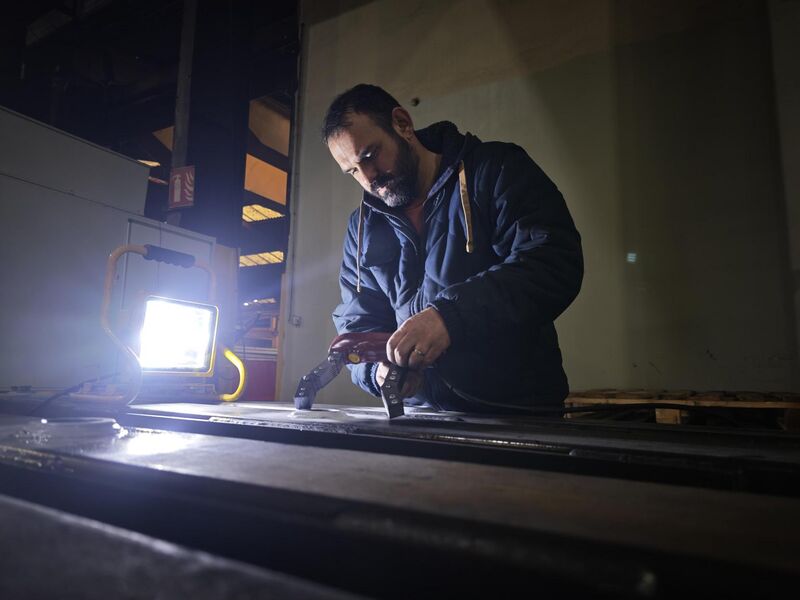
A few years ago, when our customers asked us to inspect our welds, our answer was the same as in many metalworking companies: ‘We produce quality welds.’ As part of our commitment to continuous improvement, we completely rethought our approach to welding, both in how welds are produced and in how they are inspected. Today, we can offer our most demanding customers certified weld inspections.
Step one: every welder qualified
Our welders, women and men, around twenty in total, completed training courses at Pôle formation UIMM Poitou-Charentes. All of them obtained their qualifications.
From external to in-house inspection
We then started carrying out dye penetrant testing in-house, and called on external bodies to perform certified inspections, using both dye penetrant and magnetic particle testing.
In 2025, two of our staff completed the magnetic particle testing training course run by Cetim (Technical Centre for Mechanical Industries). A very intensive course: going back to metallurgical theory after more than twenty years of hands-on workshop experience takes a great deal of commitment and of working as a pair.
We wanted to see the process through, with one goal: to have our own COFREND-certified inspector. Goal achieved at the start of 2026: one of them is now COFREND Level 2 certified in magnetic particle testing (NF EN ISO 9712 standard), in the Manufacturing and Maintenance sector.
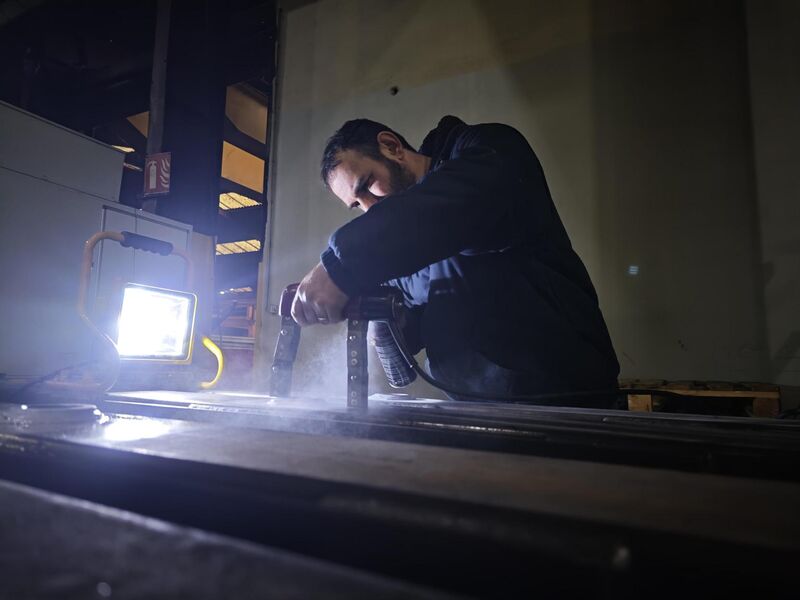
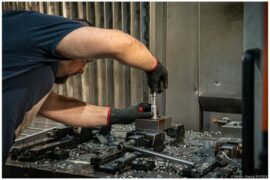
How does magnetic particle testing work? It is a non-destructive testing method for steel parts. The area to be inspected is magnetised, then a product containing fine magnetic particles is sprayed onto it. These particles gather wherever the magnetic field is disrupted, revealing cracks at or just below the surface that are invisible to the naked eye.
Next step: COFREND-certified dye penetrant testing
We are not stopping there. Another of our employees is currently working towards COFREND Level 2 certification in dye penetrant testing of welds. Our aim: to broaden our field of expertise and be able to meet all our customers’ requests.
And dye penetrant testing? A penetrant liquid is applied to the weld and seeps into any surface-breaking defects. After cleaning, a developer brings out these defects, even very fine ones.
What this means for our customers
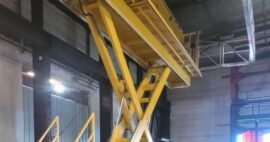
Our most demanding customers can now request certified inspections of the welds on their lift tables, goods lifts and lifting platforms, carried out by our own teams.
It is a fine example of our determination to keep improving, both in our services and in developing our employees’ skills. Well done to our two colleagues for their tenacity and commitment!
Our guiding principle for 2026: ‘Better than yesterday, not as good as tomorrow.’
Does your project require certified weld inspections? Contact us to discuss it.